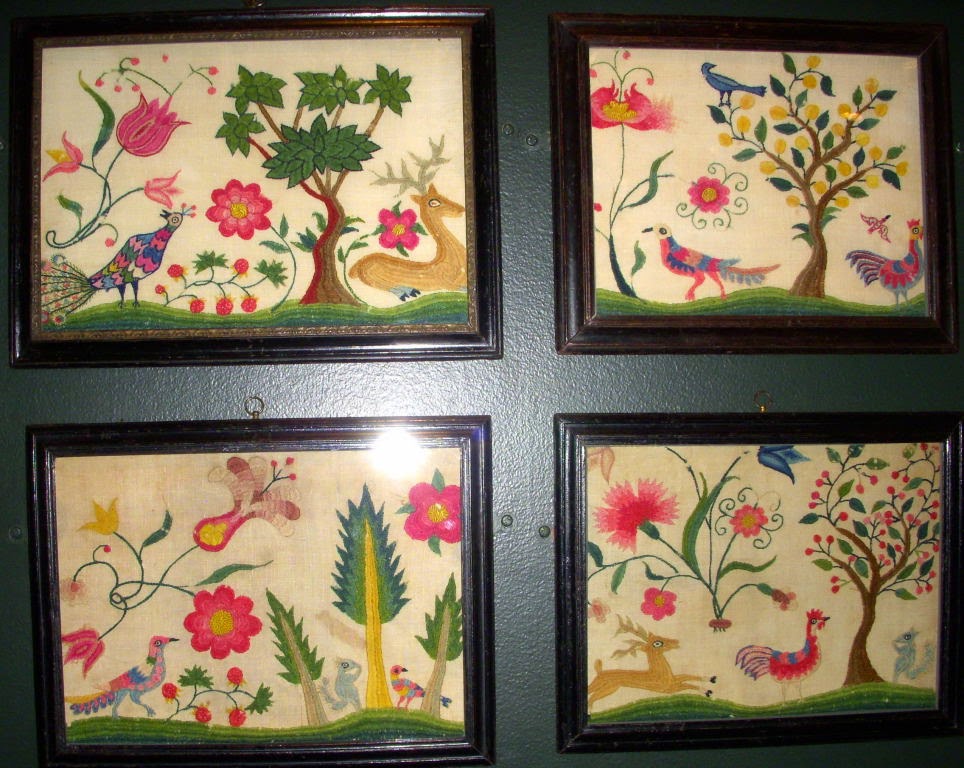
Today, Evie S., a longtime member and past President of the Princeton Chapter of EGA, whose late mother and grandmother before her were also stitchers, and EGA members themselves, invited the chapter to her home to see her collection of work over the past few years.
She's ready to pack these pieces before moving to a new home, and we got the chance to admire them before they vanished into packing boxes for the moment.
From her earliest crewel works
to her latest works in progress, in goldwork,
going through needlepoint, bargello
crewel, in a huge array of stitches and designs, we were in a kind of museum of one person's work.
And it's not all embroidery. Here's a knitted afghan with embroidered motifs added
And a wonderful quilt-like design
Stumpwork in progress, as Evie explains the construction of a leaf motif
On the left you see a piece with Hardanger and other needle forms
Evie's made wallpieces, eyeglass cases, Hanukkah gift boxes, biscornus, has worked in blackwork, in stumpwork, beading, and currently in goldwork, too, and has stitched on wool, on linen, on silk, on canvas, an amazing array of works.
Some of the pieces were items that the chapter did as a group, and there was fun for members who had worked some of the same designs, in seeing how Evie's interpretation varied from their own.
Many of her pieces are in family collections already, and here's a special one, a blackwork butterfly, worked by her mother, and destined for a nephew. Evie's seen here holding it for you to see.
Just to see and handle these lovely works in fine stitching, with great skill, was a rare treat, and to do it among friends even more so. Evie takes on challenging works, as you see from the variety of designs and approaches she's shown in this short account, and makes them look easy.
And there was food. Veggies and dips, cookies, brownies, lemon bars...very happy group this afternoon. Thank you for a lovely afternoon, Evie!
Yesterday nine EGA members and friends went on an expedition to Winterthur Museum, in Delaware, an hour and a half trip from Princeton, to the duPont estate as was, and a world class museum of antiques, furniture, porcelain and silver, with a lot of emphasis on fine stitching, works everywhere that you needed a lot more than one day to really see!
On our way in
Here's the entrance to the museum
And the official doorway
It's now open to the public, but until the end of his life the last duPont who had lived there, before he moved to a "cottage" -- huge house on the estate -- added to, and selected, the antiques we see in what is now the Museum, and was able to afford and insist on authenticity at all points. He left us all with a treasure house of antiques, history and the preservation of fine work, particularly that of women.
We had a special insider view, since one of our members arranged for a special behind the scenes tour, sorry, no pix of that one, nothing allowed in our hands, all coats, phones, purses, everything kept secure for us until that part of the day was complete.
Here I can show you Lyn, our tour guide, and Helen H., the EGA member who arranged all this.
And we had the most amazing tour of rooms, furnished as they would have been with the items of the period including wonderful stitching. I loved the men's purses everywhere, in bargello and other fine stitching, casually set down as if a moment ago. And since the light level is kept very low to protect the fabrics from uv rays, there was a theatrical moment at the entrance to each room as Lyn raised the lighting briefly so we could see, and another as she lowered the light again as we moved on. For this stitcher, there was great excitement on seeing in real life embroideries illustrated in Susan Swan's Plain and Fancy. It was like meeting a person whose picture you'd seen.
But the big gasps came when Lyn opened drawer after drawer of wonderful works, to see close up, samplers (three are out on loan to the Morven exhibit I went to a few days ago and blogged about), handkerchiefs, stitching tools, wonderful silk on linen work, endless treasures to see just inches from them. Some family items, where a mother and daughter created works, and they're curated together, or where two sisters worked items, and they're preserved together.
There are two current public exhibits: the Downton Abbey costumes, complete with projections of scenes from the series, some running live with dialog, and historical notes comparing the palatial English country home with the American one of the same era.
Teatime at Downton, note the petit fours in the background, the teabox and the lump sugar!
One example of the American equivalent: a portrait of one of the duPont ladies with her daughter, and her dressing case.
Then the other public exhibit, the initial reason for our trip, before the excitement of the additional private tour: the Diligent Needle exhibit, which examined the use of stitching and sewing for Profit, Pleasure and Ornament.
See the pockets in the case? as a little kid I used to wonder how on earth Lucy Locket could lose a pocket. That was before I came to know that a pocket in those days was tied on.
And for some women, sewing was their livelihood, a very hard one.
The diligence of young girls learning stitching and sewing was part of their upbringing, even if they were not going to have to earn a living by the needle.
Dress designers employed skilled embroiderers for work on their most elegant items, such as this fur trimmed cloak (fur a modern replica of the original trimming) and they do to this day, royal wedding dresses being one example. And the Downton Abbey exhibit has wonderful examples of dressmakers employing embroiderers in their designs.
Here's a sample stitching-store window, in the revival in the late 19th century of stitching as a retail occupation, complete with a work in progress, familiar to sight to most embroiderers.
The curator of this exhibit, Linda Eaton, a friend of one of our group, happened to be in the building and generously gave us time to guide us on this exhibit, explaining how she'd made the decisions about grouping it, how she had located and arranged for some of the pieces to appear, that the title came from an old writing she'd come across, and in general gave us a rapidfire fabulous education in the history of the textile arts. That was a huge bonus, unexpected, she not usually in the building on a Sunday, but she was in midflow of preparing lectures so she was there.
For people local to Princeton NJ, she'll be giving a lecture on January 29th at Morven, in connection with the huge sampler exhibit currently there. I think we'll be seeing her again.
Once again, we headed north to spend two blissful days in the classroom of master teacher Carol Homer, studying two forms of goldwork new to most of us.
The convent we stayed in has room for guests in the same building we had our workshop, and if you're thinking, oh, did they stay in a cell?
no, we stayed in rooms with every comfort including a rocking chair in mine, a desk with a good light, plenty of room and bedside lights, and great room names. Mine was St. Frideswide, whom I shall have to research.
Carol created two projects for us to work on, one a
dragonfly to be stitched in the or nue technique (please imagine an
acute accent, that's the right leaning one, on that final e)
Or nue is a form of shaded goldwork, where the couched thread is covered in areas with color to create the underlying design, here a dragonfly, while in this example,the gold itself forms the background. Carol had started a silver couched version, to show us how to go on with this technique, a very old one, but new to us.
and the other project,
by special request from those of us who saw Carol's finished example last time we were here, involves working with gold thread over a string background to create a wonderfully textured fleur de lys.
Carol, her own fleur de lys to her left, demonstrates how to set up the string supports for a student's work.
The work was totally engrossing, and Carol her usual generous self with advice, suggestions, reference books, endless beautiful materials, willingness to listen as well as talk, wonderful attribute in a teacher.
And here she focuses on the question posed by a student, to show her the next step.
Her reference books are rare and among the best you can study.
And to ask her a question is to get not only a complete response, but a stitched example to study, even if she has to whip it up on the spot.
One question about underside couching had her setting to work to create an example of this difficult technique -- where the tacking thread holding down the gold is pulled through to disappear into the back of the fabric, showing only the gold on the surface. She explained that this was done to create suppleness in the fabric, usually a priest's vestment.
Her own work is a teaching project in itself, just studying it and seeing the personality she stamps on her stitches, even when she's working in a tradition.
Here's a convent angel she's stitching
And a fantasy tree with great goldwork at the base.
She believes that you have to see the embroiderer in the work, the individual hand creating the effect.
She also believes that a stitcher ought to take down time frequently to allow her eyes to see further, and to straighten up her spine after being intent on a frame for a long period. Not easy to stop when you're in full flow on a stitching project.
But we managed it a time or two.
Outside the workshop, we had a spectacular rainstorm or two, and sat cozily indoors drinking tea and watching doughty birds at the feeder, and Pony, the resident pony, out in his field. The resident indoor friends, a Manx named, of course, Bob, who obligingly posed for pictures as he kept me company,
and Jennie, the mild-mannered dog who only barks when someone unauthorized shows up.
Later, we needed to walk a bit, so we used the cloister just as it was intended -- to walk dry even in rainy weather.
The building itself is a historic, preserved structure, full of staircases and corners and everywhere interesting art, from illuminated lettering, to icons, to stitching wall hangings, the work of resident and past sisters, to freshly arranged flowers, courtesy of Donna.
Aside from attending workshops -- there's one next week on iconography -- you can arrange to spend a couple of days with them on a personal retreat, to have quiet time -- silence observed from mid evening to morning, no radios, no television on unless there's a specific program of interest. No wi-fi in the guest rooms. Request to turn off cellphones throughout the building. Peace.
There's a labyrinth, built from brick by a convent team, as a devotion, in the Chartres design, which blends in with its surroundings, and this will draw your humble blogwriter back for a couple of visits, I think.
That and the birds and the walking and the great company of the sisters and their guests, and the atmosphere of learning and teaching. Happy place. Wonderful food, great consideration shown to guests, with invitations to join in religious observances but total acceptance of nonparticipation, too.
Home again now, with at least one project well started so we can continue even without appealing to Carol H. for help and advice.
Many plans to return there for another step in this journey.